 how-to
How to Structure Digital Rubrics Efficiently: A 2026 Guide
Table of Contents
- What You'll Need Before You Build a Digital Rubric
- Step 1: Define Learning Objectives and Performance Criteria
- Step 2: Choose Your Rubric Type and Proficiency Levels
- Step 3: Write Qualitative Descriptors Students Can Actually Use
- Rubric Design Best Practices That Hold Up Across a Department
- Examples of Effective Digital Rubrics in K-12 Classrooms
- Best Tools for Creating Digital Rubrics and Managing the Workflow
- Step 4: Connect Rubrics to Formative Assessment and Feedback Loops
- Frequently Asked Questions
Last Updated: September 22, 2026
What You'll Need Before You Build a Digital Rubric
A digital rubric is a scoring guide built inside your school's assessment software that turns written criteria into clickable, gradeable feedback. It replaces the printed grid taped to your desk with a version that lives where students submit their work.
Getting the structure right saves hours later. Get it wrong and you rebuild the whole thing in November.
Before you open any tool, gather four things:
- Your learning objectives, written as observable actions
- The assignment prompt students will actually see
- Your department's academic standards for that year level
- A sample of last year's student work, ideally one strong and one weak
That last item matters more than most guides admit. Writing descriptors in the abstract often fails to separate real submissions; reading two actual essays first keeps your criteria grounded.
This guide walks through the full build, from criteria to feedback loops, so your rubric holds up department-wide.
Step 1: Define Learning Objectives and Performance Criteria
Start with the learning objectives, then work backwards to criteria. "Students will analyze a primary source" gives you a criterion; "students will understand the causes of the war" does not, because you cannot see understanding.
Turn each objective into a performance criterion students can demonstrate:
- Analysis - breaks a source into claims and evidence
- Argument - states a position and defends it
- Evidence - cites specific, relevant material
- Mechanics - controls grammar and citation format
Four to six criteria suit most assignments. More than eight and neither you nor your students can hold them in mind.
Aligning Criteria With Assignment Alignment and Academic Standards
Every criterion must trace back to a standard your school already reports against. If your district publishes academic standards for the year level, map each criterion to one.
This alignment protects you if a grade gets challenged and makes the rubric reusable across teachers, so a department head can hand the same rubric to three classrooms and expect comparable results.
Assignment alignment works the other way too. If a criterion isn't taught in your unit, cut it. Grading something you never covered damages trust and skews your assessment metrics.
Step 2: Choose Your Rubric Type and Proficiency Levels
Pick the rubric type before writing a single descriptor. The type decides how many scores a student receives and how much feedback you can give per criterion.
| Rubric Type | Scores Per Assignment | Best For | Main Trade-Off |
|---|---|---|---|
| Analytic | One per criterion | Essays, projects, portfolios | Slower to grade |
| Holistic | One overall | Quick checks, presentations | No criterion detail |
| Single-point | One target level | Feedback-heavy formative work | No spread of levels |
| Developmental | One per stage | Skills built over a term | Harder to score fairly |
Most K-12 teachers default to analytic rubrics because they produce the richest student feedback. That's the right call for major assignments.
For daily work, a single-point rubric often beats a four-column grid: describe only the target, then note where the student fell short or went beyond. It takes less time and students read it more carefully.
Analytic, Holistic, Single-Point, and Developmental Rubrics
Analytic rubrics score each criterion separately. A student might earn "proficient" on argument and "developing" on mechanics. This separation is the whole point.
Holistic rubrics give one score for the entire piece. Fast, but the student learns almost nothing about what to fix.
Single-point rubrics describe only the proficient level, with blank space either side for quick teacher notes.
Developmental rubrics track a skill across time, not a single task. Use them when you're measuring growth in something like research or revision.
Proficiency levels typically run four deep: beginning, developing, proficient, and advanced. Three levels work for younger students; five create arguments about whether a piece is a 3 or a 4.
Step 3: Write Qualitative Descriptors Students Can Actually Use
Descriptors are where most rubrics fall apart. The fix is parallel structure and plain language.
Parallel structure means every level of a criterion describes the same quality at different degrees. If "proficient" says "cites three relevant sources," then "developing" should say "cites one or two relevant sources."

Student-friendly language means cutting the jargon. "Demonstrates sophisticated synthesis of disparate sources" tells a fifteen-year-old nothing. "Combines ideas from more than one source to support a point" tells them exactly what to do.
Test every descriptor against one question: could a student use this to revise without asking me? If not, rewrite it.
Parallel Structure and Student-Friendly Language
Build each row so the levels read as a ladder, not a list. Read it aloud from lowest to highest; if it doesn't sound like one quality increasing, the row needs work.
Keep descriptor length roughly even too. A one-line "beginning" next to a four-line "proficient" signals which level you expect students to reach, and it isn't subtle.
Rubric Design Best Practices That Hold Up Across a Department
Shared rubrics fail for social reasons, not technical ones. Two practices prevent most of that.
First, build the rubric with colleagues, not for them. Collaborative rubric design takes one meeting, but it produces criteria everyone already understands. Teachers who helped write a rubric use it consistently.
Second, pilot the rubric on real student work before grading anything for marks.
A short checklist before you publish:
- Every criterion maps to a standard
- Descriptors use parallel structure within each row
- Language is readable by the students who receive it
- The rubric fits on one screen without scrolling
- Two teachers scored the same sample and landed within one level
Examples of Effective Digital Rubrics in K-12 Classrooms
A middle school science rubric for a lab report might use four criteria: hypothesis, procedure, data presentation, and conclusion. Each row describes "proficient" in one sentence, and students see it before the lab starts, which changes how they take notes.
Best Tools for Creating Digital Rubrics and Managing the Workflow
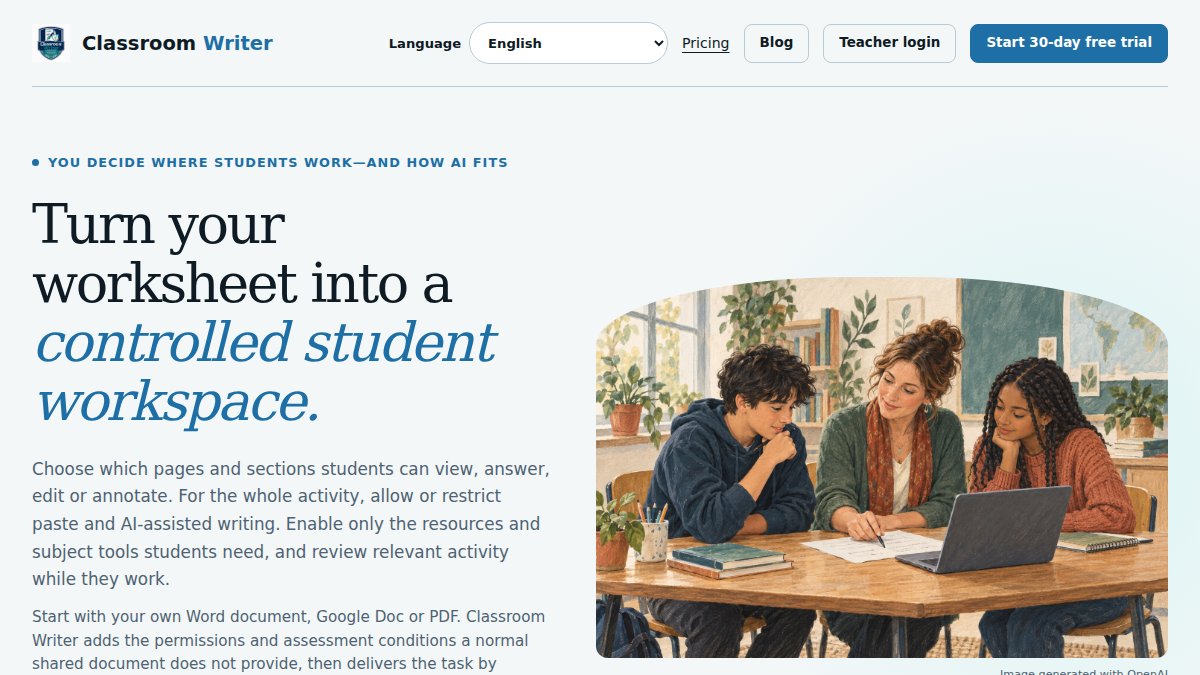
Your rubric is only as good as the system it lives in. The best tools for creating digital rubrics connect to your existing platform, produce usable data, and let teachers keep control of the content.
Three things stand out for department-wide use:
- Structured workflow - assessments move from creation to delivery to review in one place
- Content control - teachers decide what students can access and when
- Familiar flow - it fits how schools already assign and collect work
LMS Integration, UDL, and Collaborative Design
LMS integration decides whether a tool gets used or abandoned, since teachers will not log into a second platform for every assignment. Check that grades sync back to your gradebook and rosters import automatically.
Data Analytics and Rubric Reporting
A digital rubric generates more than grades: each criterion score is a data point. After grading thirty essays, you can see which criterion the class struggled with most and reteach it before the next assignment.
Step 4: Connect Rubrics to Formative Assessment and Feedback Loops
A rubric used only at the end is a grading tool; used during the unit, it is a teaching tool.
Structure your feedback loop like this:
- Share the rubric with the assignment
- Students self-assess and highlight their weakest criterion
- Peers review using the same rubric language
- You review, marking only where your read differs
- Students revise the flagged criterion
Using Rubric Data to Find Class-Wide Learning Gaps
Over a term, this loop produces rubric reporting data: you can see which criterion the whole class struggles with, then reteach it. That's assessment validity in practice, not just a score in a gradebook.
A rubric that generates data you never look at is just a fancy gradebook. The value comes from closing the loop: collect criterion scores, spot the pattern, reteach, and reassess.
Frequently Asked Questions
What are common mistakes in rubric design?
The most common mistakes are vague descriptors that students cannot act on, mismatched proficiency levels between columns, and criteria that do not map to the assignment's learning objectives. Many teachers also overload rubrics with too many rows, which slows grading instead of speeding it up. Keeping criteria to four to six rows, using parallel structure across levels, and writing qualitative descriptors in student-friendly language prevents most of these problems before they reach the classroom.
Can ChatGPT create a rubric?
ChatGPT can draft a starting rubric if you give it the assignment prompt, grade level, and learning objectives. The output usually needs heavy editing because AI-generated descriptors tend to be generic and repeat the same phrasing across levels. Use it for the first pass, then rewrite each proficiency level so the difference between them is measurable.
How do digital rubrics improve student learning outcomes?
Digital rubrics improve outcomes by making expectations visible before students start writing. When performance criteria and proficiency levels are published in the LMS, students self-assess against them during drafting, which reduces revision cycles. Teachers also gain grading consistency across sections, and the data collected from scored rubrics shows which criteria students struggle with most. That feedback loop supports formative assessment rather than one-off summative evaluation.
How do I integrate digital rubrics with the LMS my school already uses?
Most modern LMS platforms accept rubric import through CSV, IMS Common Cartridge, or a native rubric builder. The practical path is to build the rubric once in a tool that exports to your LMS format, then reuse it across sections and terms. Test the import on one assignment before rolling it out department-wide, and keep a master copy outside the LMS so updates do not break existing graded work.